
Republic County Parole Versus Probation
Release from a locked facility and release from legal control are separate events. A person can live in the community while still reporting to an officer and following a court or corrections order. The first task is to identify the source of that order. Kansas parole applies mainly to eligible older, indeterminate prison sentences. Postrelease supervision follows the prison part of most determinate sentencing-guidelines cases. Probation is imposed by a district or municipal court and can let a person remain in the community instead of serving all or part of a jail or prison term.
| Supervision | Who orders it | Best verification path |
|---|---|---|
| Parole | Kansas Prisoner Review Board for an eligible prison case | KASPER status and parole office, then KDOC confirmation |
| Postrelease | Required sentence component after a determinate prison term | KASPER and the assigned KDOC parole office |
| Probation | Sentencing court | Court docket or order and the named supervising agency |
| Community corrections | Court placement in a community-based program | Court record and supervising agency, especially for recent events |
Key terms: Discharge means the corrections system's obligation has ended. An absconder is someone alleged to have stopped complying or reporting. Neither term should be guessed from a missing roster result.
The Kansas Prisoner Review Board sets conditions for parole, conditional release, and postrelease cases, may discharge successful supervisees, and handles revocation functions. For most guidelines sentences imposed for crimes after July 1, 1993, the prison term is determinate. In those cases, the board does not make the original discretionary release choice, though it remains involved in conditions and revocation. The exact KASPER label matters because “Parole,” “Community Corrections,” and “Discharged” describe different legal positions.
Verify Republic County Post-Release Supervision
The public starting point for a KDOC-linked person is KASPER, the Kansas Adult Supervised Population Electronic Repository. It covers people associated with KDOC-operated or KDOC-funded programs, not every person who has left Republic County Jail. A person who bonded out locally and never entered a KDOC program may not appear. KASPER also says it is not a complete criminal-history repository, so its scope should not be stretched beyond corrections status.
- Accept the KASPER disclaimer and search by KDOC number or another firm identifier when possible.
- For a name search, compare birth information, conviction county, photograph, and identifiers to avoid a namesake.
- Read the precise supervision type, current status, and location or parole-office field.
- If the record shows a parole office, describe the person as released from prison to supervision, not fully discharged.
- Contact the office shown for current confirmation because KASPER updates on working days.
- For probation, compare the Republic County District Court order and contact the supervising entity named there.
KASPER's live form can filter by conviction county, parole-supervision county, location, and supervision type. Available supervision choices include Absconder, Community Corrections, Discharged, Inmate, Parole, and All. Start broad if a narrow filter returns nothing. “Discharged” may help locate a completed KDOC matter, while “Parole” points to release from incarceration with continuing oversight. A facility location usually means the person remains confined.
Republic County Salina Parole Office
KDOC assigns Republic County to its Salina Parole Office in the North Region. That assignment explains why a KASPER result tied to a Republic County conviction may display Salina rather than Belleville. The office covers people released from Kansas correctional facilities on parole, postrelease, conditional release, and accepted interstate cases. A county of conviction, a current residence, and a supervising office can therefore be three different places.
Use the office for a current, appropriate check after matching the KASPER record. District-court probation is different. The sentencing journal entry or later docket order should name the responsible probation or community-corrections path. KASPER warns that community-corrections probation events after April 21, 2021 cannot display during its system modernization. That known gap makes the court and supervising agency essential, not merely backup sources.
Republic County Supervision Conditions
Conditions are rules attached to community supervision. They can include reporting, travel or residence limits, treatment, and other case-specific duties. Public KASPER information may include non-treatment conditions, custody or supervision level, a parole-office location, and certain violation information under Kansas records law. It does not make confidential treatment or security information public. The signed order and supervising office remain the sound sources for the conditions in one case.
A suspected violation does not itself prove revocation. Under K.S.A. 75-5217, Kansas has a warrant or notice and board process for alleged parole or postrelease violations. Arrest and revocation can return someone who had been released to custody. The district court controls probation revocation in a court-supervised case. A VINE custody-change alert may flag a later booking, but it does not explain the supervision ruling or replace the agency record.
Republic County Supervision Discharge
Successful completion can end in discharge, but discharge should be supported by the responsible system's record. For a KDOC case, check the KASPER status and request the public part of the sentence or discharge record if the label is missing or contested. K.S.A. 45-221(a)(29) identifies adult-corrections fields that may be disclosed, including sentence data, parole eligibility, supervision level, facility or parole-office location, and specified violation or condition information. It does not guarantee that every item appears on the public screen.
For probation, use the court docket and filed discharge or satisfaction entry. A person disappearing from a county jail roster says only that the person is no longer on that live list. The Republic County release record and broader lookup paths are explained on the Republic County released inmates page. Physical release, transfer, supervision, and final discharge must remain distinct conclusions.
Correct Republic County KASPER Records
A stale status or image should be documented before drawing a conclusion. KASPER says its information, including absconder data, is updated each working day. An event can happen after the latest update. The repository also warns that an image date may be the date the picture entered the database rather than the day the photograph was taken. A dated image is not proof of a new custody event.
KDOC provides a direct written correction route at kdoc_pub@ks.gov. Include enough detail to identify the public entry and explain the questioned field, while avoiding needless private information. Preserve the date and time the page was checked. For an urgent status question, call the office shown in the record. This path is more reliable than trying to reconcile a stale picture, an old court event, and a current supervision label by assumption.
Check Republic County Absconder Status
KASPER maintains separate pages for parole absconders and community-corrections absconders. These are focused agency lists, not a roll of all released people or everyone under supervision. An entry indicates an alleged failure to report or similar warrant-type status. It does not prove a new conviction, final revocation, or sentence discharge.
KDOC expressly warns against making an arrest based only on website data. Do not approach or try to detain anyone. Contact law enforcement for an immediate safety concern, and ask KDOC or the supervising agency to verify the record. KASPER lists the Enforcement, Apprehensions and Investigations absconder line as 785-414-7755. Since the public data follows a working-day update cycle, the date checked is part of any careful report.
The search image below shows the official parole-absconder route. Open the KASPER parole absconder page to check the live version.
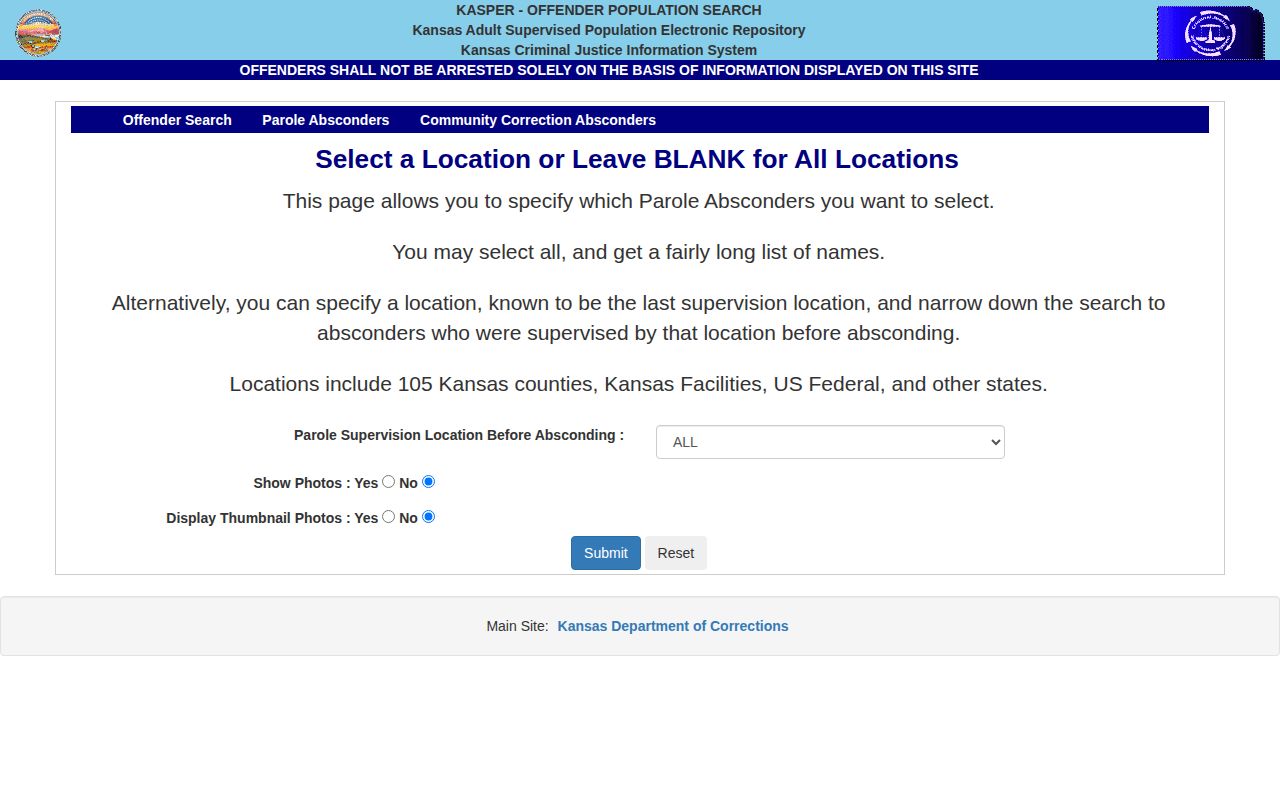
Use the page as a lead to agency verification, never as a final ruling about custody or supervision.
Republic County Parole Decisions
The Kansas Prisoner Review Board uses three key outcome terms. “Parole” means the board found the person suitable for release through the applicable process and conditions. “Continue” means deliberation was postponed for more information, votes, or an evaluation. “Pass” means parole was denied for a stated period. A hearing listing only shows that review was scheduled. It is not a grant and not proof that the prison processed release.
The board publishes a rolling public-comment and hearing cycle, but no authoritative searchable archive of individual decisions was located. After a hearing, check KASPER once working-day updates post, then request the board or KDOC decision when formal proof is needed. Even a parole decision must be followed by actual release processing, placement, and supervision. Conditional release and determinate postrelease have different legal bases and should not be relabeled as parole.